Knowledge and training · Practical guide
Write an operating procedure with AI using real work as the starting point
Write a procedure a colleague can trial and correct.
To write a procedure with AI, start with notes from the person who performs the task. Have the steps, prerequisites, exceptions and expected evidence organised into a document. Then ask another reader to follow it: the points where they hesitate show what still needs clarification.
A real task, its exceptions and an authorised owner.
Download this guide’s exercise kitA procedure should make action possible. A polished document that merely says “check the delivery and inform the manager” leaves many decisions implicit. The editable template and completed example show how to make those decisions explicit.
Which notes should you collect before asking for a draft?
Record what triggers the task, who handles it, the information consulted and the result proving completion. Ask for a normal case and one where the process changes. Find out where the documents are and what happens when information is missing.
Easily overlooked details are often the most useful: which number to copy, into which screen, where to report a discrepancy and who can approve an exception. AI cannot retrieve local rules that nobody supplies.
Microsoft describes several formats for AI-assisted standard operating procedures. Choose sequential steps for a simple task, or a branch when a check changes what happens next. The linked guide is in French.
How do you turn a vague instruction into a verifiable action?
“Check the delivery and report any issues” makes the reader invent the method. A usable procedure explains what to inspect, what to record and who decides next. It uses the vocabulary of the people doing the work, after ambiguous terms have been clarified.
| Initial wording | Actionable wording in our example |
|---|---|
| Check the delivery | Compare received item references and quantities with the identified purchase order |
| Report problems | Record missing and damaged quantities separately on the receipt form |
| Update stock | Record usable quantity according to the approved business rule |
| Close when everything is fine | The responsible person authorises closure after documented resolution of the discrepancy |
These formulations still belong to an educational example. Actual handling, safety and recording rules must come from the business. AI cannot infer them from “check the delivery” alone.
How should the steps be written?
An actionable step identifies a role, an action, the information used and evidence of completion. Replace “check the parcel” with “the receiver compares the reference and physical quantity against the purchase order, then records the three quantities in the receiving form”.
When the next step depends on a result, write both paths. With no discrepancy, the responsible person can close the record under the agreed rule. If an item is missing or damaged, closure remains suspended and the case goes to the named role. Do not add deadlines or decision-making powers absent from the notes.
Turn my notes into a procedure a new colleague can use.
Include the trigger, prerequisites, responsible role, steps, exceptions,
completion evidence, document owner and points requiring confirmation.
For every step, specify who acts and where the result is recorded.
Do not invent deadlines, approval rights or safety rules.
Place missing information under “to confirm”.
Distinguish rules in my notes from your suggestions.
Example: receiving a delivery with a discrepancy
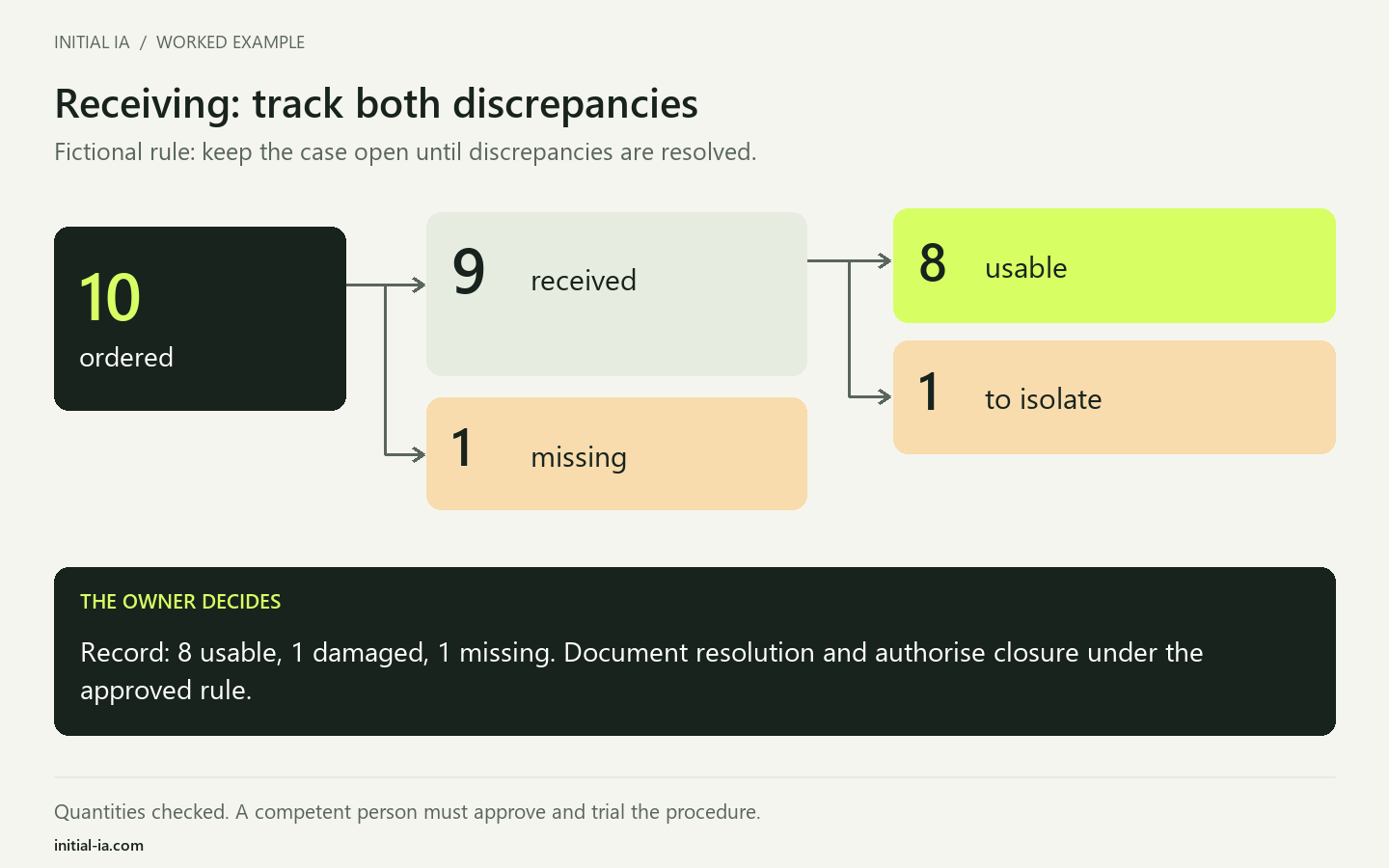
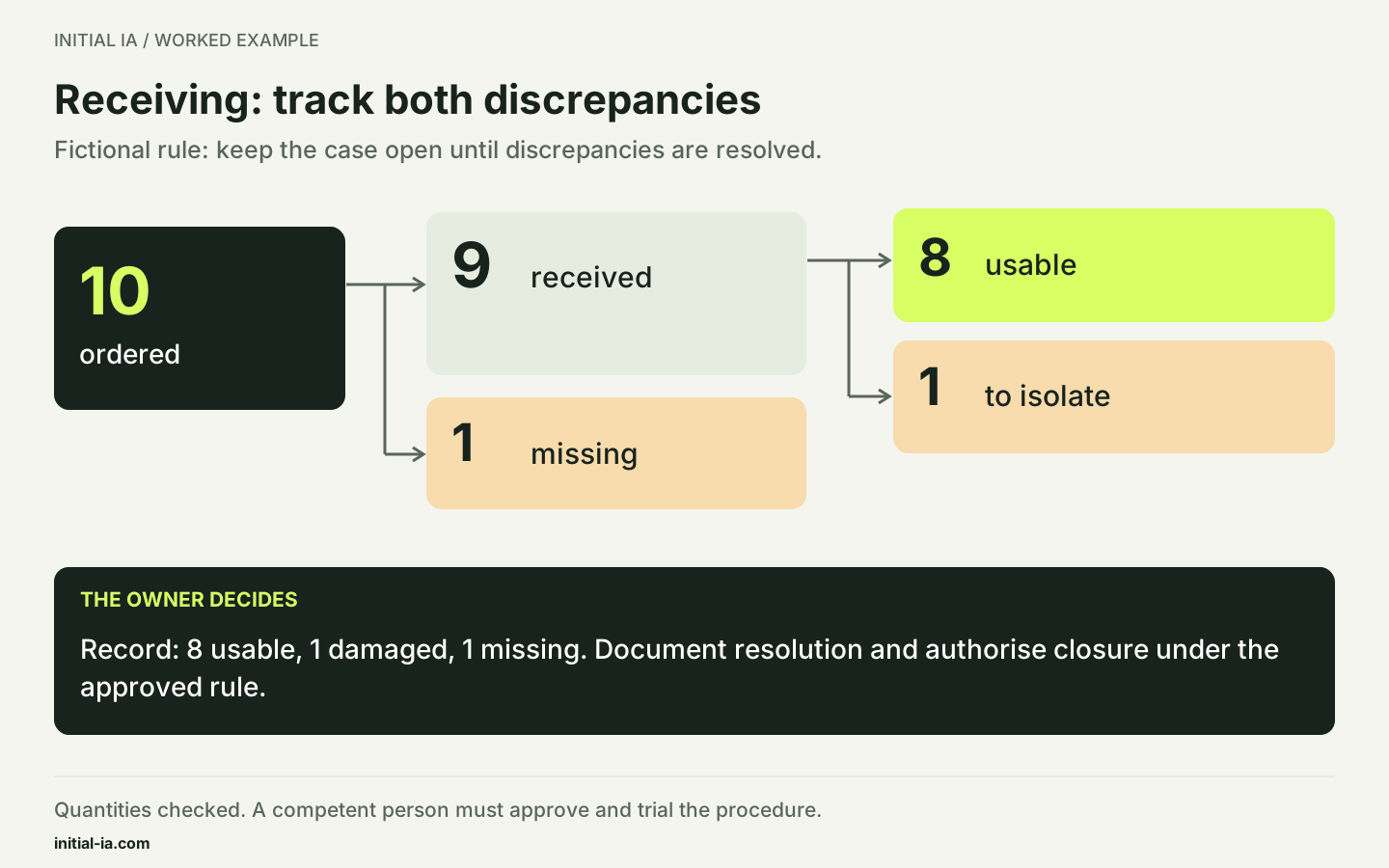
This is a fictional educational case; no physical operation was performed. Ten units were ordered. Nine arrive, one damaged. The fictional company's rule allows intact units to be recorded as available, keeps the damaged unit separate and requires the manager to address the discrepancy before closure.
“Receive the ten items” would be incorrect. The procedure must distinguish the quantity ordered, the quantity physically received and the usable quantity.
| Information | Value in the fictional case |
|---|---|
| Ordered | 10 |
| Received | 9 |
| Damaged | 1 |
| Usable | 8 |
| Missing | 1 |
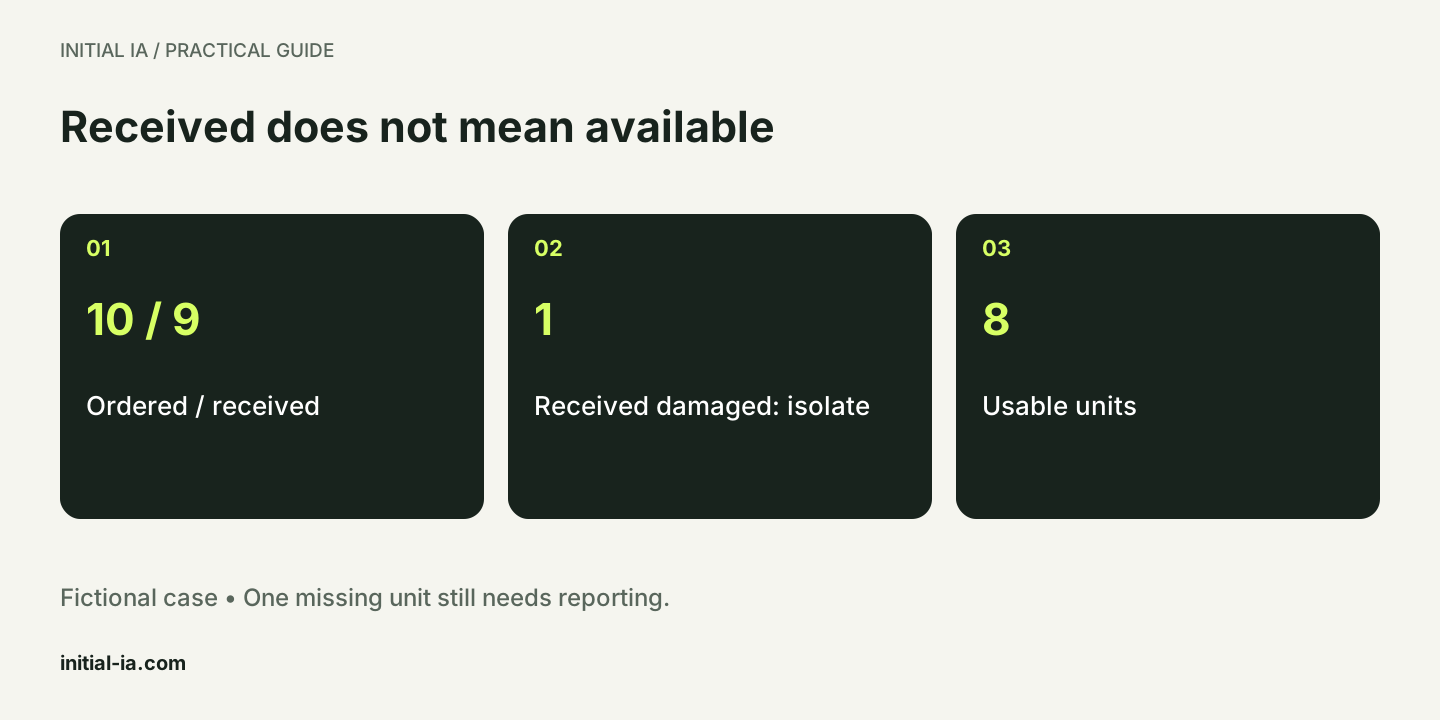
The expected outcome is not “delivery complete”. It is a quantity record, an isolated item and an open discrepancy. Your company's receiving, safety and reservation rules may differ: have their owner provide the applicable rules.
What if a step cannot be performed?
An exception should state the next permitted action. In our fictional receiving process, a missing purchase order prevents matching: the receiving operator keeps the record in the designated review location and alerts the named owner. They do not invent a reference to continue.
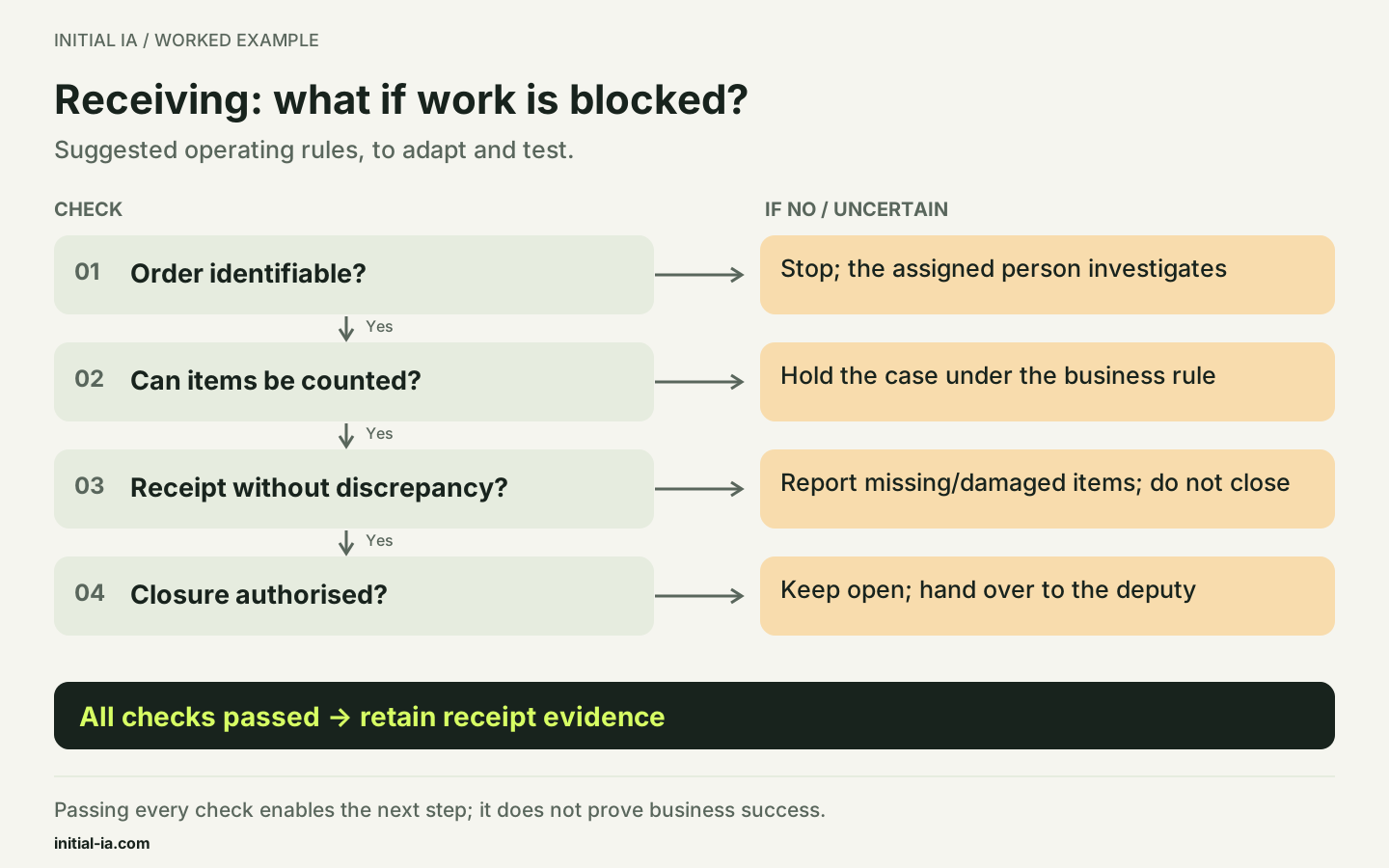
Also define what happens if that owner is unavailable. Who covers? Where does the case remain? Which action is suspended? The exception register leaves people and deadlines to complete. These depend on your organisation and cannot be replaced with a vague phrase such as “contact the right department”.
How do you test with a colleague without feeding them the answers?
Give them the working version, fictional purchase order and exercise quantities. Ask them to explain what they would do and what evidence they would retain. Record hesitation before explaining: a detail supplied only verbally reveals a gap in the document.
The colleague review scenario includes four situations: a complete delivery, damaged item, missing quantity and missing order reference. For each situation, record the understood step, expected decision, question asked and required change. Observation fields remain blank for your team.
A tabletop test mainly checks understanding and decision branches. It does not replace a practical trial with a competent person when physical actions, tools or constraints matter. After making corrections, rerun the situations that caused difficulty.
Finally, distinguish the procedure from the execution record. The procedure describes the rule and its version; the receipt form establishes what happened during one delivery. Linking them makes it possible to retrieve the applicable instruction even after the procedure changes.
In a hazardous environment, testing must follow the company's safety rules and authorisations. The kit checks the scenario's calculations and supplies a review worksheet. It claims neither an operator test nor procedure certification. A business owner must still be assigned when adapting it to your organisation.
When should the procedure be revised?
Link each version to a reason: new tool, changed business rule, incident or observed misunderstanding. A review date helps, but should not delay an already necessary correction. Approve the new rule, rerun affected cases and inform the people applying it.
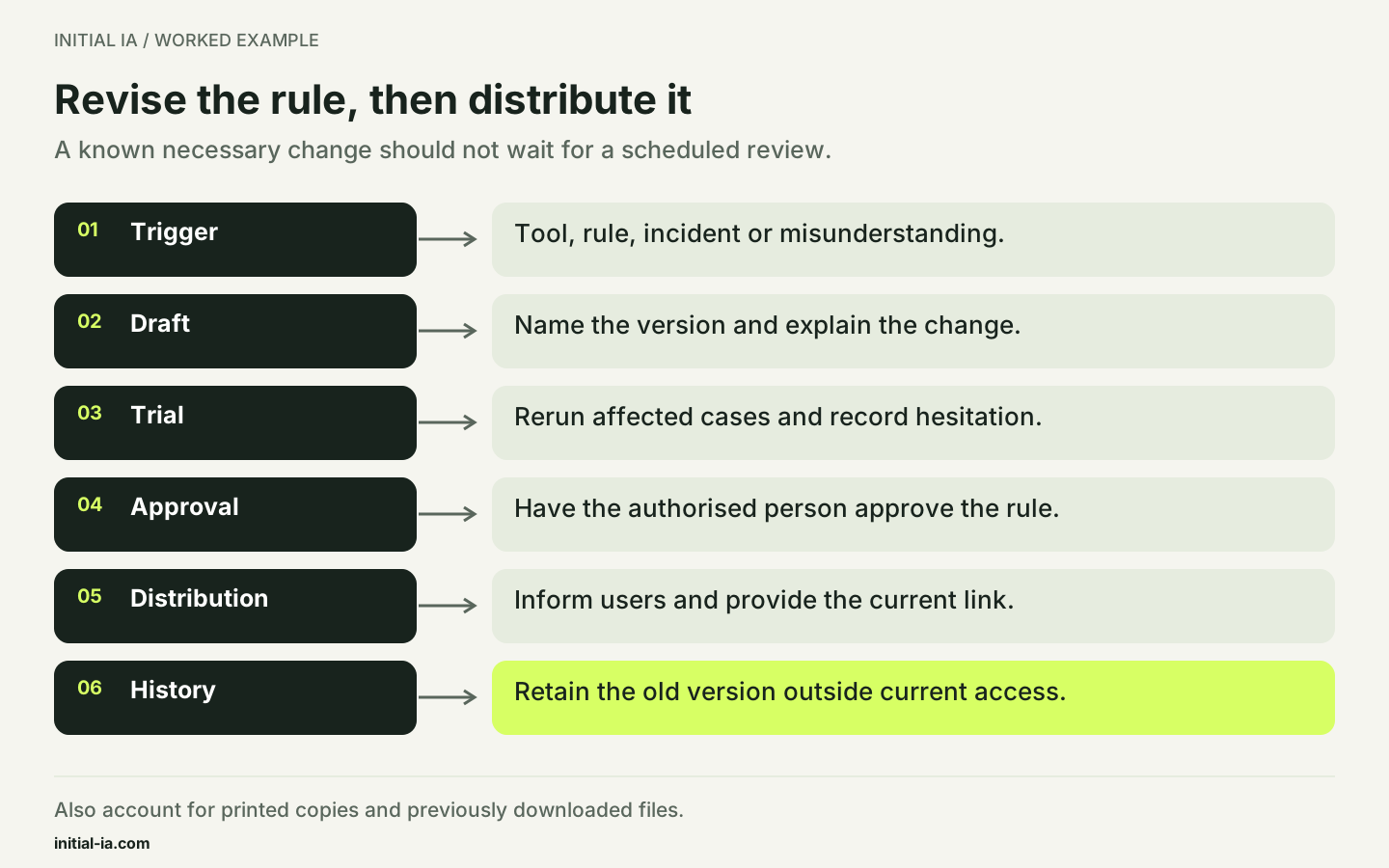
Remove the previous version from the current access point while retaining it in history. A printed or downloaded copy can remain in circulation: explain how readers find the applicable version. Finally, ask a new user to locate the procedure without knowing its exact name; a good instruction that cannot be found has little value.
Where should the approved version be kept?
Assign an identifier, owner, version number and review date. Link the procedure to its forms and references. An old copy in an email should remain identifiable as old, without becoming a competing source of truth.
Your decision: the owner is unavailable
Fictional case: one unit is damaged and the procedure reserves closure for the owner. That person is absent and no deputy is named. What should happen?
- A. Close the case because the discrepancy has been reported.
- B. Keep the decision pending, use the authorised escalation route and complete the procedure.
- C. Ask AI to appoint an authorised decision-maker itself.
Read the explained answer
B. Reporting a discrepancy does not grant permission to close it. The missing deputy is a gap to resolve with the procedure owner. The revised rule must identify who decides, where the case waits and what remains suspended. More elegant wording cannot replace an undefined responsibility.
Adapt this: for each reserved decision, what agreed route applies when its owner is absent?
Should you document the entire company at once? Start with a repeated task, something explained frequently or a process dependent on one person. A procedure that is genuinely used is worth more than a folder of documents nobody reviews.
Can a document assistant use it afterwards? Yes, using approved versions and appropriate permissions. The assistant should retrieve the authoritative procedure rather than deciding alone between contradictory copies.
Initial Brain can organise these documents and how the team uses them. To prepare that knowledge system, see the company second-brain guide.
Written by Initial IA, 26 September 2026. Expanded on 27 September 2026. Reviewed on 1 October 2026. Fictional case and arithmetic check; business validation is required for each adaptation.
Try it yourself.
Find fictional documents, blank templates and answer keys in the practical kit.
Download this guide’s exercise kit