Business analysis · Practical guide
Analyse customer reviews with AI: turn comments into actions
Turn reviews into a verifiable question with correct counts.
To analyse customer reviews with AI, group comments by topic, retain the quotations supporting each classification and verify the counts. A sentiment summary alone is insufficient for a decision: you need to know what is wrong, which comments describe it and how far the finding can be generalised.
A dated dataset, sources and deduplication rules.
Download this guide’s exercise kitThe exercise CSV contains ten fictional reviews and one repeated entry to exclude. You can use it without sharing real customer data and compare your results with the separate answer key.
What does analysing customer comments involve?
A verbatim is a statement preserved in its original wording. Analysis can identify a topic, a specific problem or an evaluation. These dimensions should remain separate. “Delivery was late, but your team kept me well informed” discusses delivery and support, with two different evaluations.
Specialist tools can propose groups and summaries; HubSpot describes customer-feedback analysis in this way. A feature's availability does not prove that its categories fit your business. Define your own questions before interpreting a dashboard. The linked vendor description is in French.
How do you keep the analysis framework stable?
Write a definition, included example and excluded example for each topic. “Delivery” might cover timing, tracking and drop-off location; a “support response delay” belongs under support. Resolve ambiguous cases before changing the classification vocabulary.
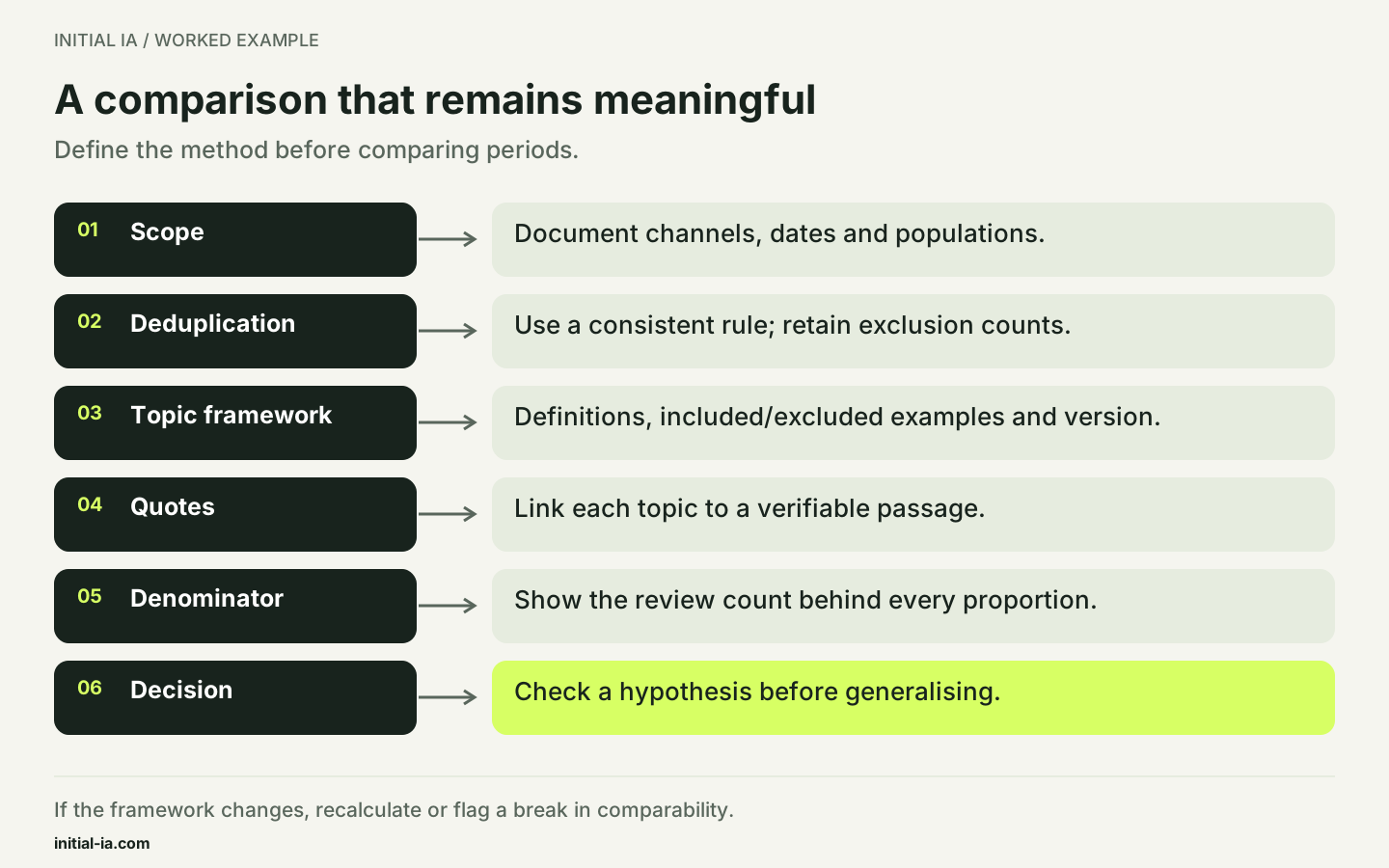
When a category changes, version the framework. Recalculate earlier periods using the new definition or flag a break in comparability. The chart should show its underlying basis: an apparent trend can reflect a change in method rather than customers.
How do you obtain classifications that can be checked?
Define the topics and allow several categories per review. Ask the AI to show the passage supporting each label, then check difficult cases: irony, very short comments, mixed languages and topics absent from the category list.
Analyse the attached reviews using these topics: delivery, support, quality.
Allow several topics for one review.
For each association, provide the identifier, topic and an exact quote.
Separate the topic from a positive or negative evaluation.
If the wording is ambiguous, write “review needed” and explain why.
Never invent a quote. Do not generalise to all customers.
Finish with questions to check before making a decision.
Calculate numbers from validated rows using a spreadsheet or script. Do not rely on a model alone to remember a long list and infer its totals. The kit's script verifies ten unique identifiers, thirteen associations and the topic counts in the manual answer key; it does not evaluate a classification model.
Why can ten reviews produce thirteen mentions?
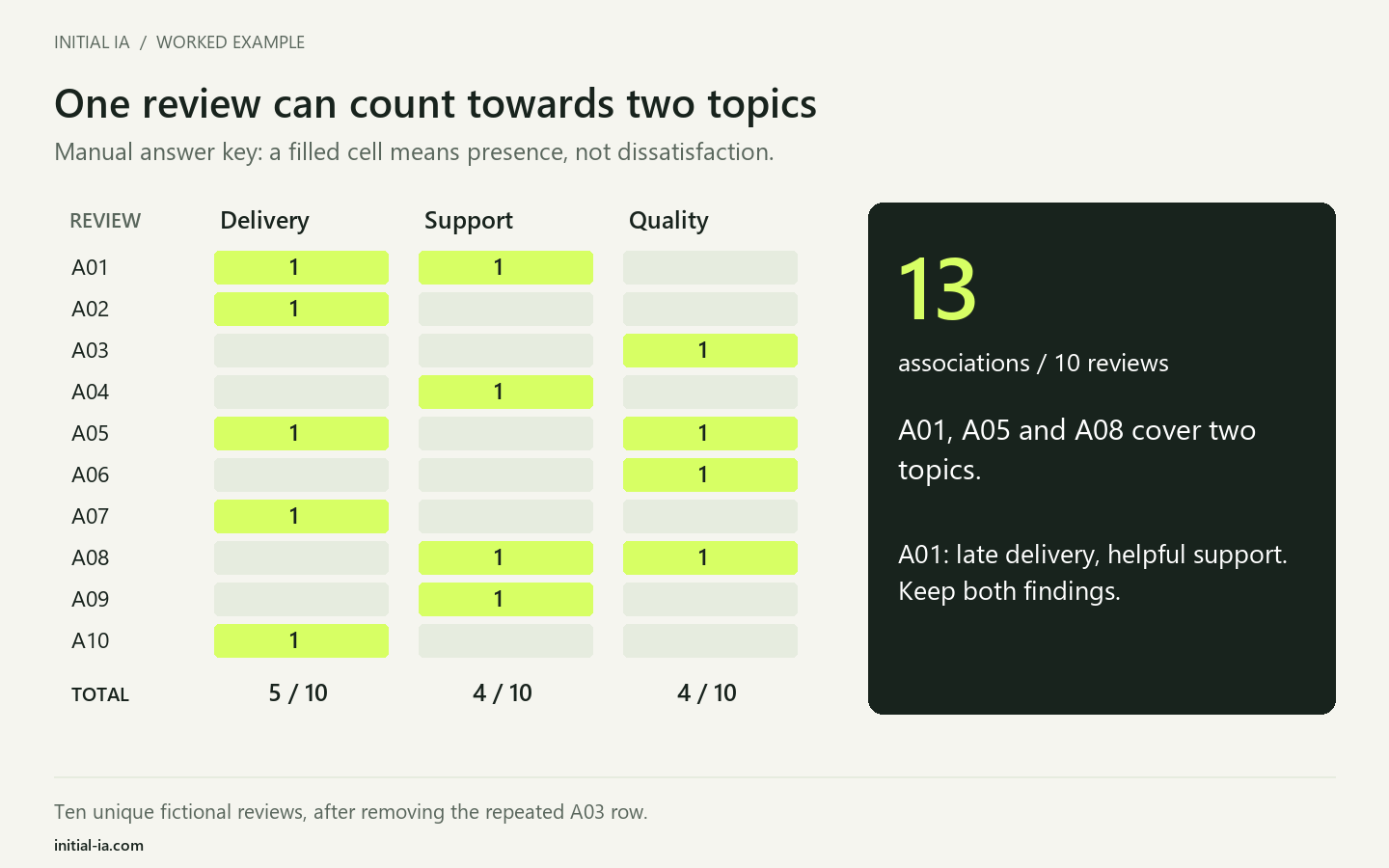
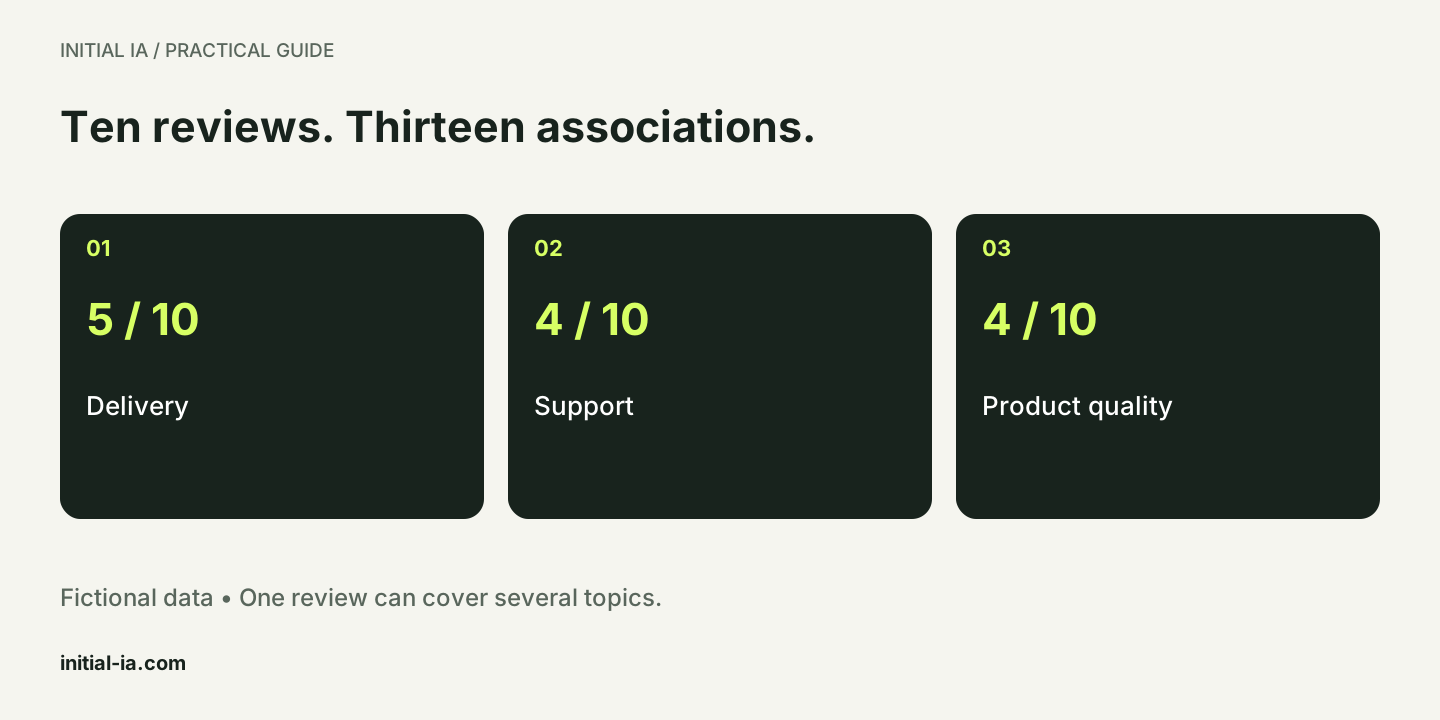
One comment can concern several topics. In our exercise, five reviews mention delivery, four support and four product quality. Three reviews cover two topics. There are therefore thirteen review-to-topic associations across ten unique reviews.
| Topic | Reviews concerned | Share of the ten reviews |
|---|---|---|
| Delivery | 5 | 50% |
| Support | 4 | 40% |
| Product quality | 4 | 40% |
These percentages can add up to more than 100% because the categories are not exclusive. They are not a customer dissatisfaction rate. “Support” may be mentioned positively. The first mistake to avoid is turning every mention of a topic into a complaint.
The file also contains a second occurrence of A03 with the same identifier and text. The answer key excludes it. In a real export, identical text posted by two people is not automatically a duplicate: retain the identifier, source and collection context.
How do you read several topics in one review?
Review A01 says: “Delivery was late, but support kept me informed.” It contains two pieces of information: a delivery problem and positive feedback about support. Assigning only one overall sentiment would lose that distinction. A05 combines fast delivery with a damaged part; A08 combines helpful support with a product defect.
The matrix below shows the thirteen associations in the manual answer key. Each row represents a unique review. A filled cell means the topic is present; it does not by itself indicate a problem.
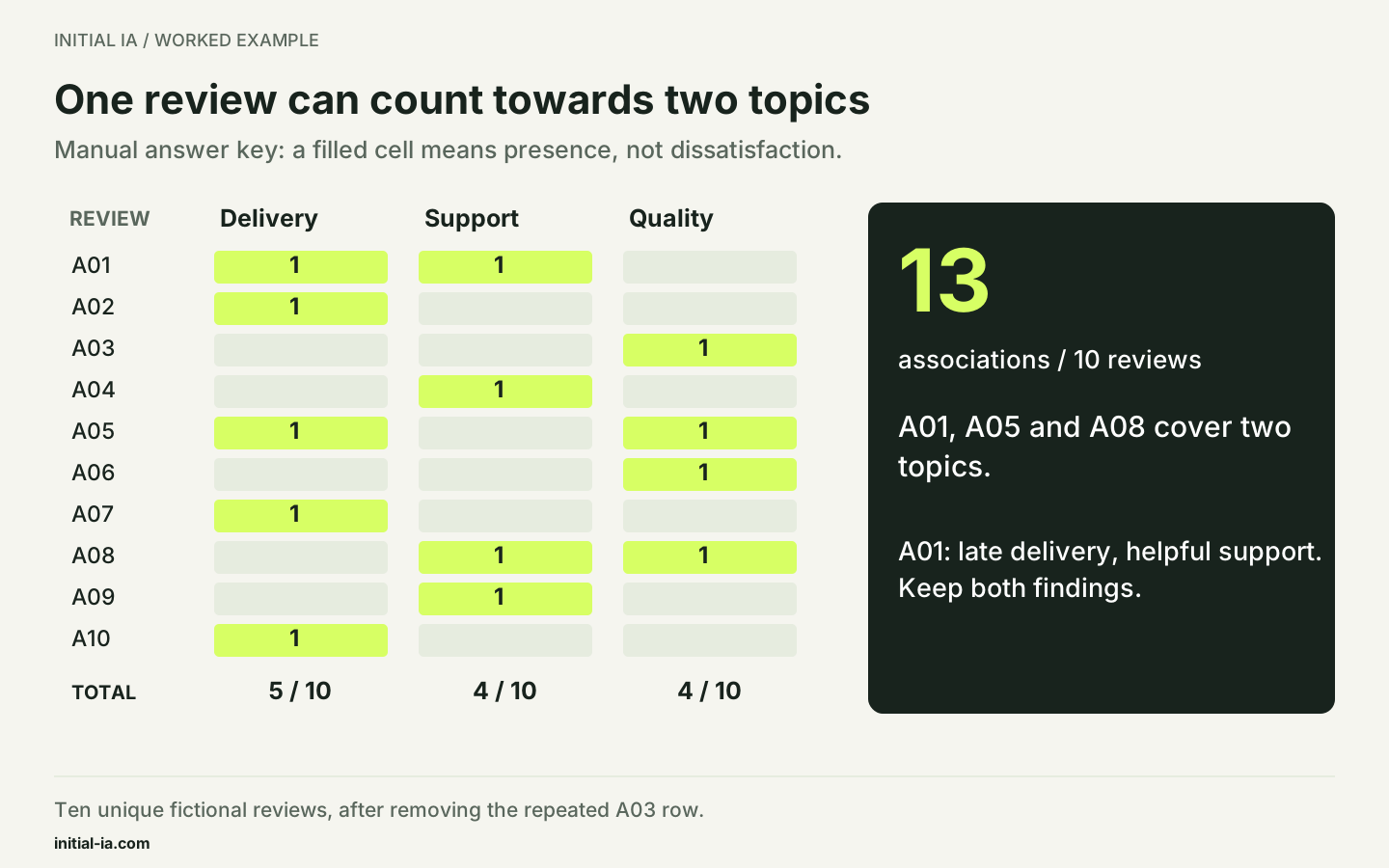
The review-by-topic worksheet can be filtered in a spreadsheet. To go further, add sentiment for each association, a short quote and any uncertainty. Keep those columns separate: a confidently detected topic can express a mixed opinion.
Do more mentions mean a worsening problem?
Not necessarily. In an exercise separate from the earlier ten reviews, period A contains 100 reviews, 20 mentioning delivery. Period B contains 200 reviews, 30 mentioning delivery. Mentions rise by 50%, but their share falls from 20% to 15%, a reduction of five percentage points. Neither figure alone establishes improving or worsening satisfaction.
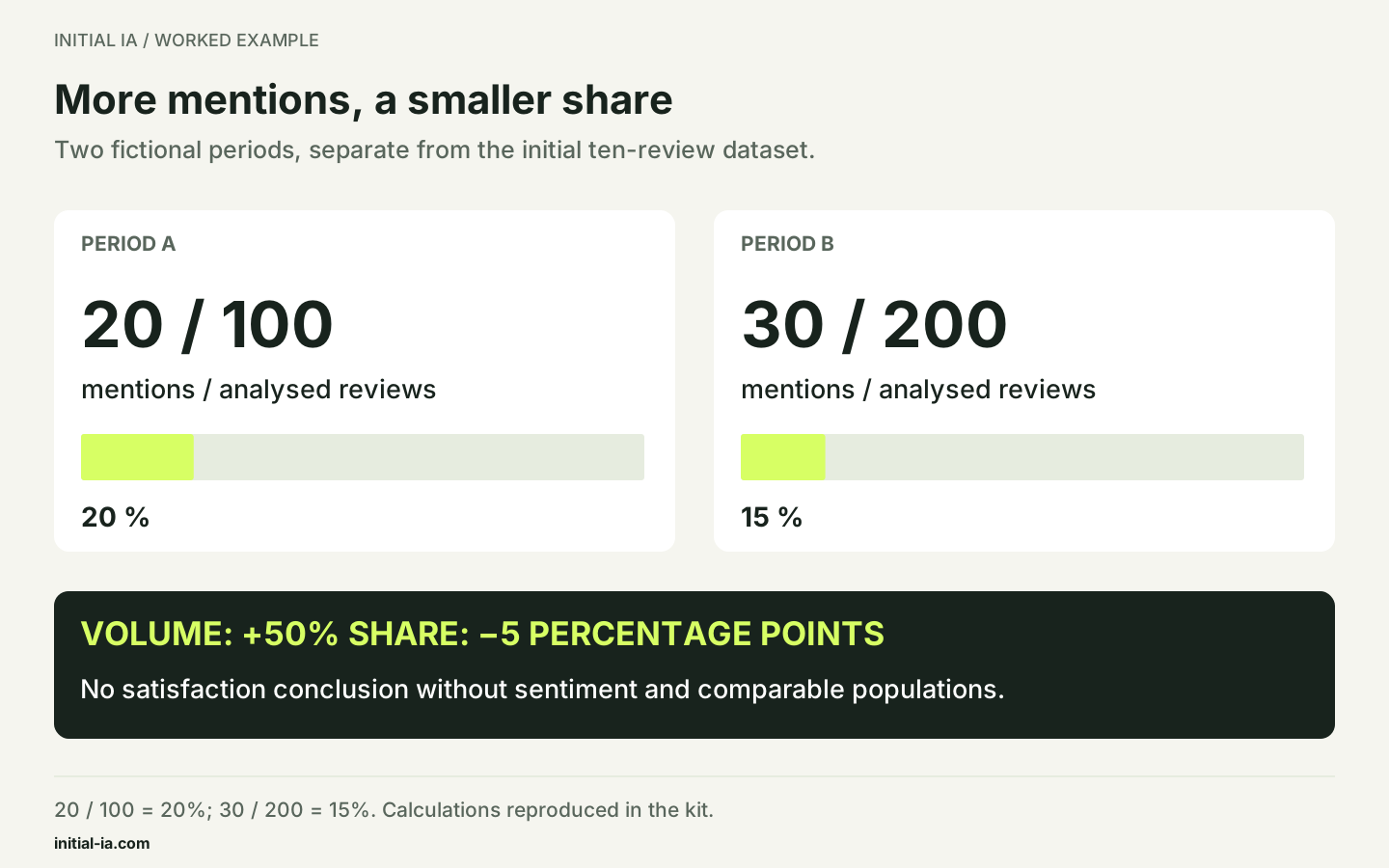
The period dataset lets you reproduce the calculation. Interpretation still requires checking review sources, collection method, covered period and the sentiment of the mentions. A channel change can alter who contributes feedback.
Which action should follow the summary?
Reread the relevant comments before assigning a correction. “The parcel arrived late” may require a logistics check. “I did not know when the parcel would arrive” may point to an information problem. Grouping both under “delivery” makes them easier to find but does not dictate the same action.
Start with a verifiable question, rather than a conclusion about all your customers. In our small fictional set, A07 expresses uncertainty about parcel arrival. One possible action is to examine tracking availability and the messages sent at that stage. The real journey and the frequency of the problem across a relevant dataset still need checking.
| Observed signal | Hypothesis to investigate | Check before deciding |
|---|---|---|
| A07: parcel arrival unknown | Insufficient tracking information | Examine the journey and available messages |
| A04: unanswered question | Incomplete reply or incorrect routing | Read the exchange and its history |
| A05: damaged part | Product, packaging or transport problem | Examine case evidence |
Assign a person and a date to every selected investigation. Retain the reviews behind the decision so its starting point remains explainable.
The next measure depends on the action: tracking availability, questions actually answered or recurrence of a defect. The number of generated summaries does not reveal whether the customer's problem was solved.
Which limitations should remain visible?
Ten comments illustrate a method; they describe neither your customers nor the market. A particular period, a survey sent only after complaints or a single collection channel can strongly affect the findings. Show the source, period, number of reviews and exclusions.
Your decision: what do the two periods establish?
Fictional case: delivery mentions rise from 20 out of 100 reviews to 30 out of 200. Management asks whether customers are less satisfied. Which answer is supported?
- A. Yes, because mention count rose by 50%.
- B. No, because the share fell by five percentage points.
- C. Topic frequency changed; sentiment and population comparability still need examination.
Read the explained answer
C. The calculations in A and B each describe a real change in the exercise, but their satisfaction conclusions do not follow. A mention can be positive, negative or neutral. Check quotes, methods and collection channels before concluding. The calculator displays both denominators to avoid selecting only the number supporting an idea.
Adapt this: what rules help your team distinguish a mention from a confirmed problem?
Try your assumptions in the calculator. Calculations stay on your device; no data is sent.
Can public reviews and support tickets be combined? Yes, to explore themes, provided their origins and populations remain distinct. A ticket and a review may describe the same incident: do not automatically present them as two different customers.
Should names be removed before a test? Start with fictional data. For real feedback, follow internal rules and limit shared information to what the analysis needs.
To connect findings to your tools or train the team in this method, Initial IA offers integration suited to the process. Start with a business question and a small dataset you can check; use our guide to sharing data with AI to define the inputs.
Written by Initial IA, 26 September 2026. Expanded on 27 September 2026. Fictional reviews and categories; reproducible calculations, not real customer findings.
Try it yourself.
Find fictional documents, blank templates and answer keys in the practical kit.
Download this guide’s exercise kit