Working methods · Article
Using AI for a tender response without inventing your capabilities
Use AI to read tender documents, connect requirements with evidence and draft a response without inventing capabilities or commitments.
AI can help read tender documents, identify requirements and produce an initial draft. It cannot certify that your company holds a qualification, has completed a reference project or has a team available. Its most useful role is to connect each requirement to supporting evidence before you start writing.
The danger begins when writing comes first. “Our support team is available around the clock” can sound natural in a proposal. It may also become a commitment your business cannot deliver.
First decide whether you can respond
Imagine a small maintenance company considering a contract covering several locations. AI can help identify sites, deadlines, required skills and submission documents. The first decision remains human: can the team deliver this service during the specified period?
Separate eligibility requirements, evaluation criteria and delivery obligations. Their status depends on the tender. Something important to the evaluation is not automatically a mandatory exclusion criterion; read the applicable wording.
French public procurement distinguishes, among other things, the application documents from the offer itself. Required documents and response procedures must be checked against the particular consultation. Preparing an application; preparing an offer.
That French legal context should not be applied automatically to private or overseas tenders. In every case, have commitments that might exceed your capabilities reviewed by a responsible person.
Connect requirements with evidence
Ask the tool to preserve the document name, version and location of each passage it uses. A summary without references makes returning to the exact wording difficult.
Here is a fictional example for the maintenance company:
| Identified requirement | Information actually available | Decision before drafting |
|---|---|---|
| Attendance within a specified time | Staff schedule and travel areas | Confirm actual coverage with operations |
| Particular technical qualification | Current certificate, or no certificate | Establish compliance or record the gap |
| Experience at a comparable site | Record of work genuinely completed | Verify its scope and permission to cite it |
| Service continuity during holidays | Cover arrangements still undecided | Do not present those arrangements as confirmed |
A blank cell is useful information. It identifies a decision to make or a question to raise through the tender’s permitted procedure. The assistant should not fill it with something plausible.
Check annexes and any updates as well. An outdated set of documents can produce a coherent response to the wrong requirements. If two passages contradict each other, keep both references and resolve the issue before selecting an interpretation.
A requirement, supporting evidence, then a drafted response
Consider this entirely fictional tender extract: “The bidder shall describe how requests for sites A and B are handled Monday to Friday, 08:00 to 18:00, and how the customer is informed after an intervention.”
Within this fictional case, the business has an operations manager receiving requests, two technicians assigned to those sites and a report sent after each intervention. Operations has confirmed these arrangements. No maximum travel response time has been validated.
A usable draft would be:
Requests for sites A and B are received by the operations manager Monday to Friday, 08:00 to 18:00. The manager assigns each request to one of the two technicians designated for those sites. After the intervention, a report describes the work completed and any follow-up required, and is sent to the customer contact specified in the file.
This describes an established arrangement. It invents neither overnight cover nor immediate attendance. In the working file, connect these statements to the schedule and reporting template used; then adapt submitted evidence to the documents actually requested.
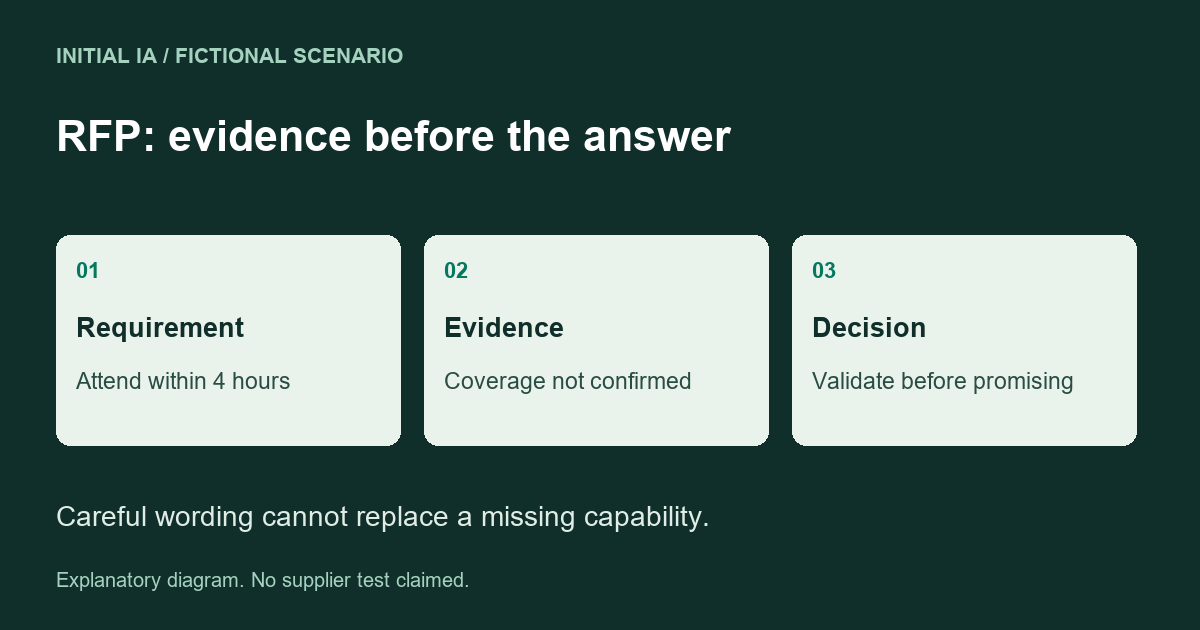
If another clause requires attendance within four hours, this paragraph is insufficient. Verify that the commitment can be met, clarify it through the authorised channel, or decline if the condition cannot be satisfied. Cautious language cannot make an inadequate arrangement compliant.
The drafting instruction can be brief: “Respond only to the quoted requirement using the confirmed capabilities below. Mark missing information ‘to confirm’ in the working version and identify the question to resolve. Invent no figures or commitments.” Resolve those markers before submission: they help prepare the bid, not replace a required answer.
Provide only approved references that may be shared in the chosen environment. Previous bids may contain prices, names and commitments belonging to other customers that have no place in this response.
A sales review is not enough
Before submission, the operational owner checks commitments, the person responsible for pricing checks amounts, and the bid owner checks the required documents and format. In a small business, one person may hold several roles; the checks remain distinct.
Look particularly for consistency between the written proposal, price and schedule. An option removed from pricing must not remain promised in the narrative. Anonymising a reference should not change what that project demonstrates.
Finally, use the required submission channel and deadline, and retain the available submission receipt. Producing a complete file does not prove that it was received. Preparing and submitting the offer in the French public procurement context.
AI helps when it makes a bid easier to examine and its gaps easier to see. It becomes expensive when fluent writing hides missing evidence. The strongest benefit is discovering earlier what you can actually promise.
Sources checked on 9 October 2026. The maintenance example and sample wording are fictional; no real tender was submitted for this article.