Comparison · Article
Files in your AI, or memory integrated into your work?
Your assistant may be enough to prepare a one-off meeting. To resume a file as a team and retain approved decisions, also examine how information flows, who has access and who maintains it.

A colleague takes over a client file tomorrow. They need to find the latest decision, prepare the meeting and know what to keep afterwards. Choose the arrangement that lets them do this work with sources they can check.
Pick up a file before the next meeting
Illustrative example: an agency hands a file to someone who did not attend earlier discussions. Either approach can fit, depending on the available tools and how information is maintained.
The team gathers documents and instructions in its assistant. Someone keeps them current and checks answers.
Sources, access and connections are organised around the file. The agent proposes updates and an authorised person approves them.
Examine a practical benefit: finding the decision, consulting its source and knowing who will correct the information after the meeting. Integration is justified by what your current arrangement lacks.
Start with what your tool already does
A shared project can meet the need when a few people use the same assistant, keep documents current and follow clear instructions. Another application is worthwhile only when it solves an identified working problem.
ChatGPT projects reuse files and context across related conversations. Claude projects also bring conversations and knowledge together. Capabilities depend on the version, account and settings. Presenting these as conversations without persistent context would be misleading.
An integrated memory adds a workflow question: how are business facts selected, linked to files, corrected and made available to authorised agents? That organisation should justify the integration work.
Compare two approaches on your own use case
| Decision | Assistant with files or projects | Integrated team memory |
|---|---|---|
| Starting point | Organise documents using your subscription's features. | Define a use case, sources, owners and required connections. |
| Updates | Assign responsibility for adding, removing and replacing project information. | Define an input, proposal and approval workflow for the files. |
| References | Test which sources are actually used on your questions. | Test references retained in notes and exposed to agents. |
| Access | Examine product sharing and administration settings. | Define roles and verify access throughout the integration and connectors. |
| Daily tools | Use connections available for your account and configuration. | Qualify the connections; price custom development separately. |
| Operations | Assign responsibility for documents and project settings. | Also assign responsibility for integration, hosting and backups. |
An integration can use your existing assistant. It does not automatically require a different model.
When an assistant project can be enough
A firm keeps templates, method notes and a client file in one shared workspace. One person maintains the sources. The team checks answers before using them. If access is suitable and the organisation remains usable over time, make it work first. Naming files, removing outdated versions and writing clear instructions may help more than another technical project.
Test on a real file: does the assistant retrieve the right decision? Can you identify the supporting document? Who updates it after the next meeting?
When integration deserves investigation
Several agents may need the same context. Decisions change often, sources span tools or a reviewer must approve changes before reuse. In those cases, specify the information flow: is a note a raw observation or an approved decision? What supports it? Who can replace it? Which version did an agent read? How is unusable information withdrawn?
A more powerful model alone does not answer these questions. Scope, working rules and checks on the real tools are needed.
Where Initial Brain fits
Initial Brain integration organises file memory that an agent can consult and enrich by proposal. A human reviewer examines the sources and approves, edits or rejects the change. The galaxy helps navigate notes and their links.
The first proposed use case is resuming a file before a meeting or intervention. The €4,800 excluding VAT standard scope includes one use case, up to five users, one compatible AI, one qualified standard connection and integration scoping. The offer details initial documents, acceptance, onboarding and limits.
The provider, model and environment follow client constraints. Local models need suitable hardware and operations. External APIs have their own data path. A private architecture must describe where processing actually happens.
Compare the full working cost
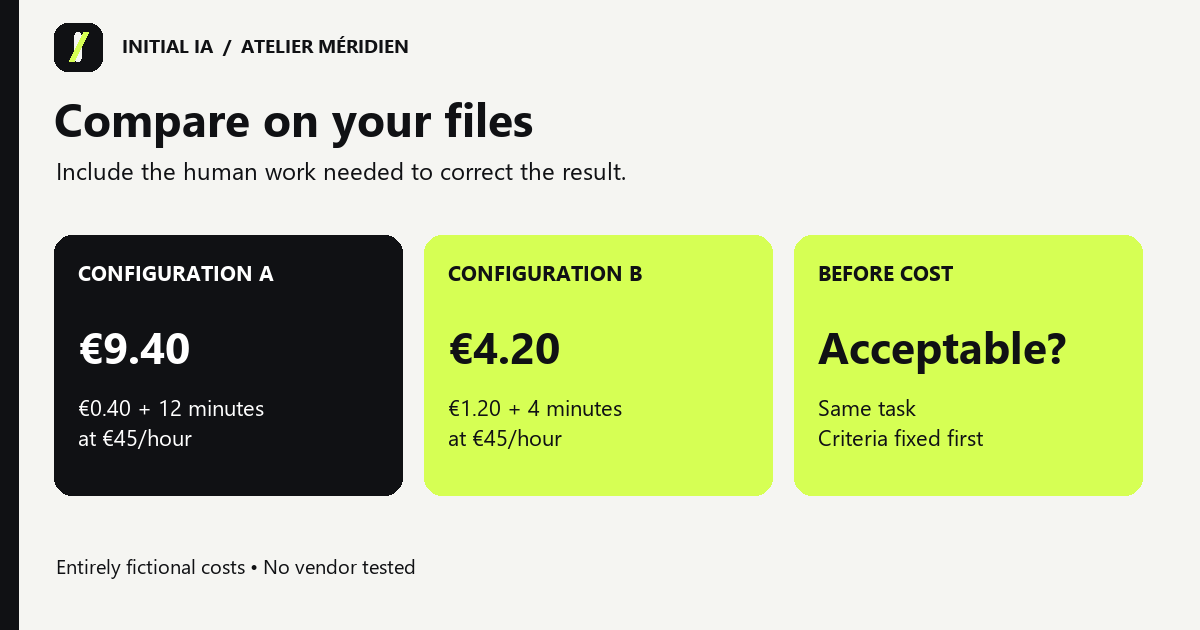
For an assistant project, count subscriptions, associated tools and source maintenance time. For an integration, add preparation, connections, acceptance and documentation, then the recurring costs of the chosen environment.
| Cost item | What a proposal should state |
|---|---|
| Initial work | Use case, document volume, users, connections and deliverables. |
| Licences and consumption | Payer, account and budget. |
| Hosting | Environment, capacity and operating owner. |
| Updates and incidents | Included work, separate charges and service hours. |
| Handover | Exports, documentation, access and responsibilities at the end. |
Optional Brain support is €180 excluding VAT per month for two scheduled hours, separate from licences, hosting and AI consumption. Third-party subscriptions are not assumed to be included in integration.
Start with a conversation
Discovery and the initial quotation are free. We first examine whether your current tool is enough. A deeper technical study may be proposed separately at €600 excluding VAT, only with prior agreement. It is not mandatory for a quote. If followed by the same-scope standard integration, it is included in the €4,800 total.
Five questions to decide
- What concrete work should be easier to resume?
- Where are the sources and who maintains them?
- Who should read, propose and approve?
- Which connections are essential for the first use case?
- Who will operate the system after handover?
If your assistant already answers these needs, strengthen that organisation. If rules or connections are missing, price a first scope that allows you to test them.
Discuss your use case for free.
Sources
- OpenAI project documentation, consulted 19 October 2026.
- Anthropic project documentation, consulted 19 October 2026.
- Initial Brain scope and prices.