Costs and decisions · Article
AI chatbot pricing: what actually changes the budget?
Understand AI chatbot pricing across setup, subscription, usage and maintenance, with a transparent worked example and clear billing distinctions.
An AI chatbot’s price goes beyond its subscription. To compare proposals, add setup, usage, information maintenance and human intervention. Then check what each supplier calls a billable conversation, message or outcome. Identical monthly figures can cover very different services.
One question prevents many unhelpful quotations: what will the chatbot be allowed to do? Answering opening-hours questions from an approved page, retrieving an authenticated customer’s order and changing that order are three different scopes.
Scope explains part of the price
A public information assistant works with material anyone may read. A connected customer-service assistant must also identify the correct record and respect the requester’s permissions. An assistant that takes action needs authorisation, error handling and confirmation of the result.
Implementation cost therefore depends on more than the number of pages uploaded. A business-system integration can require more work than designing the chat window. An unclear action remains risky even when it is easy to program.
Ask the supplier to describe one complete conversation: its starting point, information consulted, possible action, failure conditions and transfer to a person. That description gives you a common service to compare.
The most misleading line: “usage included”
There is no universal billing unit. Contracts may count messages, conversations, credits or particular outcomes. Allowances, overages and excluded usage also matter.
For example, Intercom’s Fin documentation distinguishes billable outcomes including resolution, certain procedure handoffs, and qualification or disqualification. It states that only one outcome is charged per conversation, even when several actions occur. “Outcome-based billing” therefore does not necessarily mean “a problem solved without human involvement.” Fin pricing FAQ.
Before signing, ask the supplier to explain the charge for three conversations: an immediate answer, several successive exchanges and a transfer to your team. Also ask what happens if the same customer returns the next day. A clear contractual definition is more useful than an attractive unit price.
A real price reference, checked on 9 October 2026: Intercom advertises Fin from US$0.99 per outcome. Its platform plans add seat charges; using Fin with another helpdesk involves a minimum monthly commitment. This is neither a complete project budget nor an average for the French market. Intercom’s public pricing.
A budget example, with its assumptions exposed
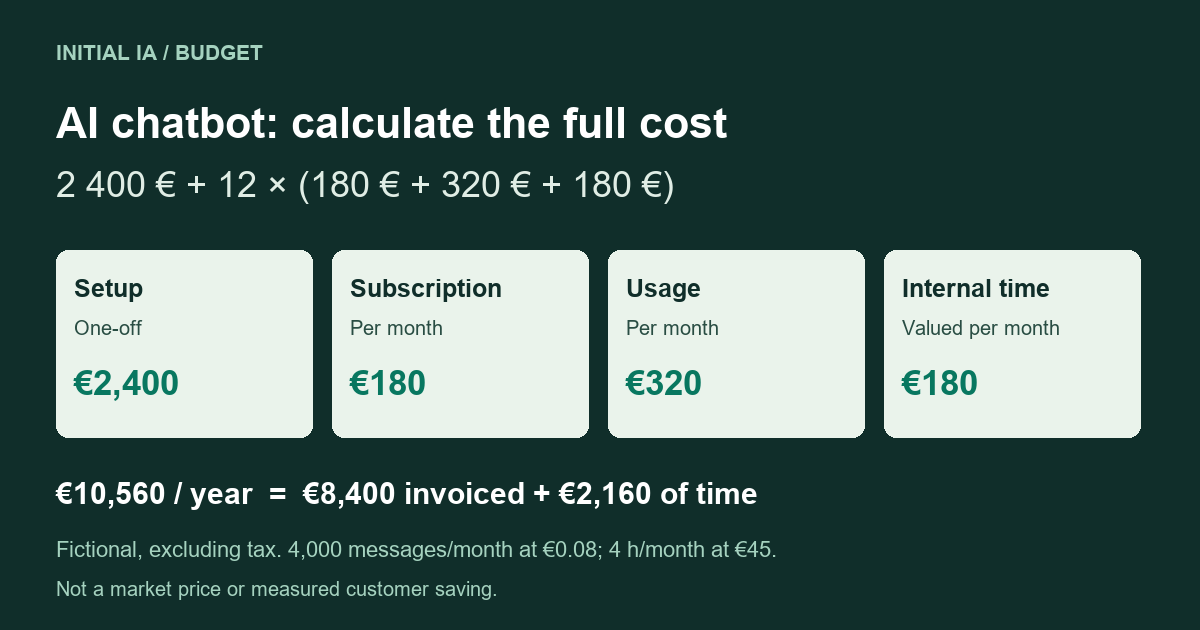
The following calculation is entirely fictional and does not represent any supplier’s prices. Amounts exclude tax. Internal time is valued to compare economic cost, rather than presented as an additional external invoice.
| Item | Assumption | Cost |
|---|---|---|
| Setup | Once | €2,400 |
| Subscription | Monthly | €180 |
| Usage | 4,000 messages at €0.08 | €320/month |
| Internal maintenance and checking | 4 hours at €45 | €180/month |
| Total operation | Subscription + usage + time | €680/month |
| First year | €2,400 + 12 × €680 | €10,560 |
At 8,000 monthly messages, usage becomes €640. Operating cost rises to €1,000 per month and the first year to €14,400, if checking time stays unchanged. That assumption may not hold: more requests can also create more corrections and handoffs.
These figures are neither a market price range nor a return-on-investment promise. They show why volume must use the contract’s billing unit. Two thousand website visitors do not automatically mean two thousand conversations, much less two thousand billable outcomes.
Two quotations: the cheaper option changes as conversations get longer
Compare two fictional offers with assumed equivalent functionality and 1,000 monthly conversations. Offer A charges a €180 subscription plus €0.08 per message. Offer B charges €300 plus €0.25 per conversation, regardless of message count in this example. These amounts exclude setup and internal work.
| Average messages per conversation | Offer A | Offer B |
|---|---|---|
| 2, giving 2,000 messages | €340 | €550 |
| 4, giving 4,000 messages | €500 | €550 |
| 6, giving 6,000 messages | €660 | €550 |
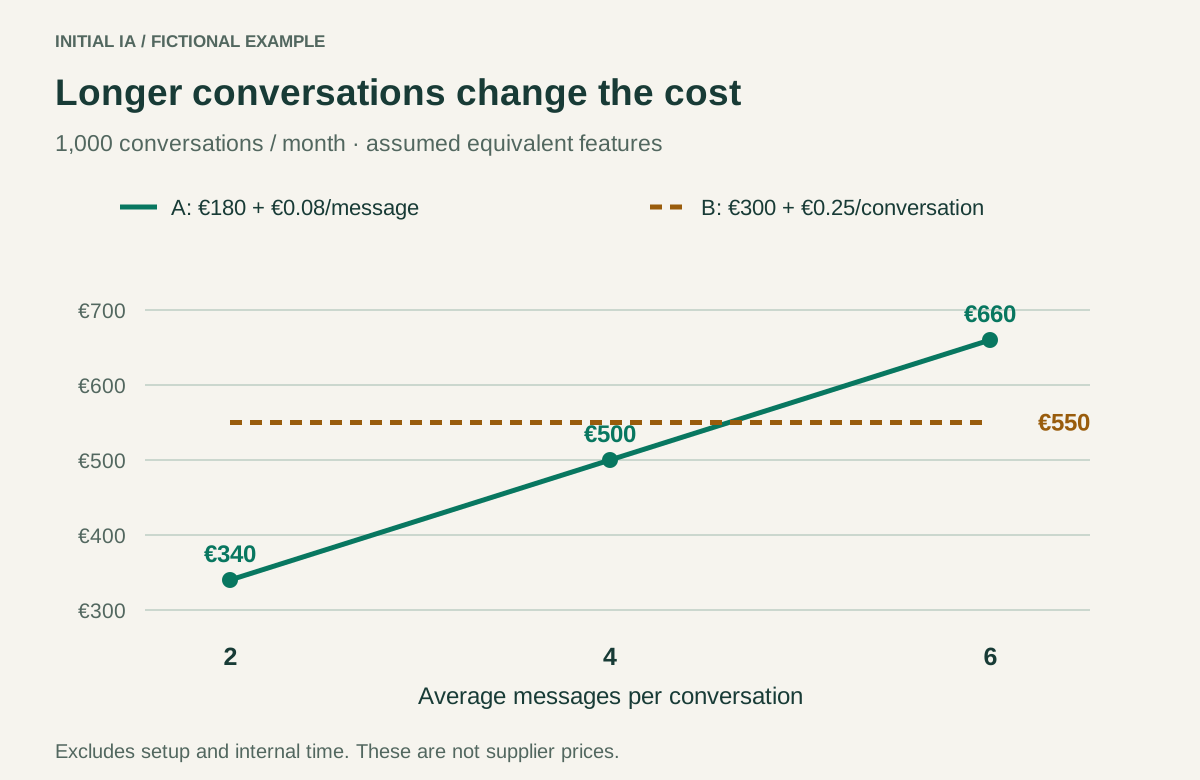
Per-message pricing can work well for short exchanges and lose that advantage as conversations grow longer. Check whether the contract counts questions, answers or both as messages. Comparison requires a sample of your conversations and the supplier’s counting rules; visitor numbers alone are insufficient.
In the original €680 monthly budget, €500 is supplier expenditure and €180 is valued internal time. The first year therefore means €8,400 of supplier expenditure, including setup, plus €2,160 of internal time. Keep them separate for cash planning, while retaining both for the economic decision.
What remains after installation
Someone must update opening hours, commercial terms and answers that become outdated. Someone must also examine failed conversations and check that transferred requests reach the right person.
The quotation should assign those responsibilities. “Maintenance included” remains vague if nobody knows whether it covers technical failures alone or corrections to the information. Establish how you can recover your content, settings and permitted history if you change supplier.
A small budget can make sense for an assistant answering a narrow set of stable questions. The same figure becomes misleading if it supposedly includes a business-system integration, continuous availability and ongoing improvements that have never been costed.
When is the investment justified?
Start with requests that actually occupy your team. Their frequency matters, but so do their cost and difficulty. A chatbot answering many unimportant questions can appear busy while removing little work.
After launch, compare total cost with correctly handled requests and the staff time still required. Record handoffs, corrections and abandoned requests separately. A closed conversation alone does not prove that a customer is satisfied.
The right budget funds a useful, maintained and verifiable scope. If the quotation does not make that scope understandable, clarify it first; the headline price is not yet enough to decide.
Pricing documentation checked on 9 October 2026. All amounts in the worked example are fictional.